



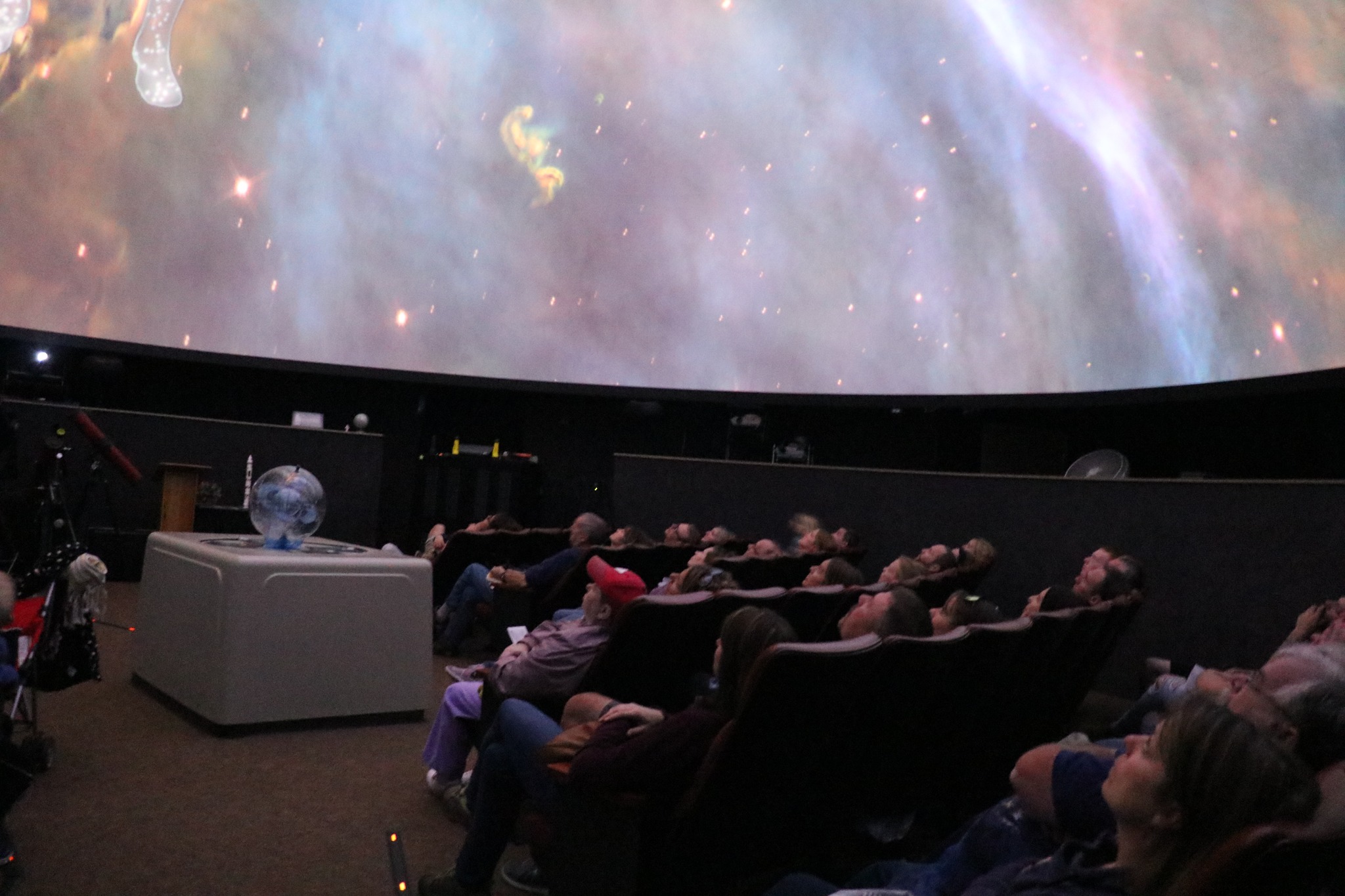
All shows are held at the Horwitz-DeRemer Planetarium located inside the Retzer Environmental Learning Center. Private show reservations are available for community groups, private parties, corporate events, or scout groups. If seats are available you can purchase them up to the time of the show. For more information or to register a group, call 262-970-4139.
Tickets are available at https://hdplanetarium.ticketleap.com.
April Planetarium Programs
April Saturday Shows
May Planetarium Programs
May Saturday Shows
June Planetarium Programs
June SATURDAY SHOWS
July Planetarium Programs
July SATURDAY SHOWS
August Planetarium Programs
August SATURDAY SHOWS
SPECIAL EVENT
The Charles Horwitz Planetarium opened in May 2005. The state-of-the-art, 90-seat, Digistar-6 planetarium is owned and operated by the School District of Waukesha. With the new, high-definition laser projection system, guests can fly through the rings of Saturn, land spacecraft on Mars and travel at light speed to stars and distant galaxies… all without leaving their seats!
In the Spring of 2018, the planetarium was renamed: Horwitz DeRemer Planetarium after David A. DeRemer, who was the director of the planetarium from 1978 to 2018.
The planetarium is not only an accurate day and night sky projection system, but the program serves as a district and community science resource center. School and community programs are designed to meet state and national astronomy standards, but these programs also present fundamental science concepts of weather, climate, chemistry, physics, and earth science.
The entrance to the planetarium, lobby area, and the theater are completely wheelchair accessible.
Expand your experience by enjoying the Retzer Nature Center facilities and grounds!
3-2-1 Liftoff! Space Adventure of Elon the Hamster (3K-3rd grade)
Elon is a hamster scientist who lives in a junkyard and tries to fit in with the local rat community, but no one takes him seriously. The rats ignore his scientific experiments, which often fail. One day he hears a crash and discovers a crater in his garden with a damaged robot inside. After fixing it, Elon learns the robot fell from a spaceship heading to Mars that leaves in three days. Determined to help, Elon begins a big adventure to return the robot to its ship before it departs.
Aurora: Lights of Wonder (6th grade +)
Experience the aurora borealis as if you were there! Thanks to the pioneering work of astrophotographer Kwon O Chul. "Aurora: Lights of Wonder," filmed on location in Yellowknife, Northwest Territories, Canada, features high resolution, hemispherical video recorded in real-time with a special camera system that captures the subtle detail, colors, dynamism and beauty of the aurora. In addition, scientific explanations and beautiful artwork about the legend of the aurora are featured throughout the show.
Beyond Our Senses: Bank Swallows
Each spring, thousands of Bank Swallows Riparia riparia (also known as the Sand Martin) return to the bluffs of Lake Michigan, transforming it into a symphony of flight and survival. With senses beyond human perception, they build vast cliffside colonies, hunt insects on the wing, and raise the next generation in a race against time. Beyond Our Senses invites audiences to witness the world through their eyes, a world of hidden colors, slowed time, and aerial mastery, revealing the unseen forces of the world that guide their survival.
CapCom Go! The Apollo Story (5th grade+)
On July 20th, 1969, 600 million people worldwide gathered to witness a historic moment of human achievement broadcast live from the Moon. “That’s one small step for man, one giant leap for
mankind” Neil Armstrong. The world celebrated as the astronauts took their first steps on the Moon. But few people were aware of just how huge an effort it was to get them there. These Apollo 11 astronauts were just 2 of nearly 400,000 people who worked over ten years towards this goal. But how did they do it? What did it take to put humans on the Moon?
DinoSoars! Change Over Time (4th grade +)
Perhaps the most astounding discovery about dinosaurs is that they are still around today – and not just in the movies. Birds are living dinosaurs! Follow the story of Malkia, a museum paleontologist, as she explores fascinating connections between birds and dinosaurs.
Forward! To the Moon (4th grade+)
Kari Byron from “Crash Test World” and “MythBusters” launches us on a journey beyond the Earth towards a sustainable future in space. NASA’s 21st century Artemis program, named after the Greek moon Goddess and twin of Apollo, is the next step in our mission to explore the universe and land the first woman and person of color on the surface of the Moon.
Galileo: The Power of the Telescope (6th grade +)
This beautiful and historic program, produced by the Daniel Soref Planetarium at the Milwaukee Public Museum celebrates 400 years of telescope viewing. The program also examines the
fascinating life and scientific accomplishments of Galileo.
It’s About Time: Cosmic Cycles We Live By (5K+)
Time impacts us everyday — but what is it exactly? Where does time come from? Explore these mysteries and many more in the Planetarium’s newest creation. Join friendly robots Tortoise and
Hare in their voyage around the Earth and beyond to discover the wild origins of time!
Mars: The Ultimate Voyage (4th grade +)
Ever wondered what it will take for astronauts to travel to the Moon, Mars and beyond? On this long journey, what challenges will astronauts face? How will they stay motivated and healthy on their spacecraft so far away from Earth? Mars: The Ultimate Voyage, explores these questions and more!
Max Goes to the Moon (4K-3rd grade)
Max (the dog) and a young girl named Tori take the first trip to the Moon since the Apollo era. Along the way, the story sets the stage for the more sophisticated science of the "Big Kid Box" sidebars, which cover topics including "Phases of the Moon," "Wings in Space?", and "Frisbees and CurveBalls of the Moon"- all thoughtfully explained so that grownups and children can learn together about science. Toward the end, Max and Tori's trip proves so inspiring to people back on Earth that all the nations of the world come together to build a great Moon colony from which "the beautiful views of Earth from the Moon made everyone realize that we all share a small and precious planet."
Mysteries of Your Brain (3rd grade +)
Mysteries of Your Brain takes you on an immersive, animated adventure into the human brain, exploring how the brain works and what makes human brains so special. Your tour guides on this
journey are a curious girl and her crow companion—together you’ll zoom along the paths of neurons, fly through brains and experience illusions on a grand scale. You’ll learn how your brain makes you you and that, ultimately, we each have the power to change our brains.
One Sky Project (4th grade +)
Each short film represents the perspective of a different culture or Indigenous society from around the globe. Each film stands alone as a short story or in combination as a longer narrative – organized around themes of "Finding Patterns" and developing tools, or as we say, "To Seek Far."
Our Place in Space (4K-3rd grade)
This award-winning children’s planetarium show introduces jungle animals and a space crossword puzzle to explore the wonders of the universe. This program will inspire your young astronomer to appreciate the beauty of the night sky.
Secret of the Cardboard Rocket (5K-4th grade)
Join two children on a magical journey through the Solar System, aided by a talking astronomy book, a cardboard rocket, and a vivid imagination. During this imaginative show, audiences will land on Venus, fly through the rings of Saturn, and discover the secrets of the Solar System.
Seven Wonders (5th grade+)
Turn back the pages of time and witness the ancient wonders of the world as they appeared thousands of years ago. Explore the Great Pyramid, stand in the shadow of the towering Colossus
and experience the rest of the world’s Seven Wonders along with investigating how the wonders were created.
Sky Wars: Battles of Discovery (4th-8th grade)
Explore epic battles of change in the sky above us. Follow the struggles, as new discoveries alter our view of Earth and its place in the universe. Witness the connections, and conflicts, between
astronomy and astrology. And lastly, voyage into the galaxy to glimpse how future discoveries might start new battles about the sky above!
Star Signs (8+ years)
The astrological signs take their names from the star patterns people found long ago in a sky they considered sacred and influential in the affairs of Earth. Although we see things differently today, we can still go outside and find these patterns in a sky filled with signs and stories of our own making. And those stars can still guide us, not from the pages of a newspaper, but in real ways that can link us with the past and lead us to the stars.
Stellar Women in Astronomy (3rd grade +)
“Stellar Women in Astronomy” is a dynamic planetarium show celebrating trailblazing women who transformed our understanding of the universe. From Hypatia’s ancient wisdom to Caroline
Herschel’s comets, Maria Mitchell’s stars, and Henrietta Leavitt’s galaxies, to modern pioneers like Katherine Johnson, Vera Rubin, Jocelyn Bell, and Katie Bouman, this inspiring journey shines a spotlight on brilliance too often overlooked. Discover how their groundbreaking discoveries continue to shape astronomy and inspire future generations of stargazers.
Surviving in Space (Ages 6+)
Ever dream of rocketing into space or being an astronaut in Earth's orbit? Explore these fascinating journeys and beyond with NASA astronaut Karen Nyberg and her robot helper, S.L.O.T.H.! That’s short for Space Life Operations Trainer for Humans. Join us for this fun Planetarium program for all ages.
The Case of the Disappearing Planet (Grades 1st-5th)
After a frenzied phone call from a 3rd grade teacher, a sly, street-smart gumshoe named Skye Watcher collects clues to find out what happened to the planet Pluto and looks into the changing
status of objects we call “planets.” It not only covers Pluto, but the temporary planetary status of asteroids as well. The tally of “planets” in our Solar System has been going up and down for hundreds of years!
The First Stargazers (4th grade +)
This show investigates the mysterious alignments of the pyramids. Travel with us to Stonehenge, and other giant astronomical sites to see the incredible structures, made by the first stargazers.
The Solar System Show (5K +) Looking to explore way out worlds? Join us as our delightful students present their spectacular show about the sun, moon, and planets. Climb aboard as we land on sand dunes of Mars, zoom in on the red spot of Jupiter, and fly through the rings of Saturn.
The Sun, Our Living Star (5th grade +)
The Sun has shone on our world for 4.5 billion years. The light that warms our skin today has been felt by every person who has ever lived. It is our nearest star and our planet's powerhouse, the source of the energy that drives our winds, our weather and all life. Discover the secrets of our star in this planetarium show and experience never-before-seen images of the Sun's violent surface.
Totality- Explore the Wonder of Eclipses (6+ years)
This show is all about eclipses, from lunar to total solar. Discover how they occur and what happens when they do. We look back to the proof of general relativity and look forward to upcoming eclipses and where to witness them. Learn from spectacular space environments to humorous pop-up books. Experience under the dome what will happen when you are caught in the shadow of the Moon and the Sun is plunged into a total solar eclipse.
Treasures of the Milky Way (5K-4th grade)
Treasures of the Milky Way is a captivating planetarium show where a knowledgeable pirate teaches
stargazing essentials. Using star charts, cardinal points, and navigation tools, audiences learn to find
constellations and celestial treasures. This show makes astronomy fun, guiding viewers to the perfect
night of exploration.
Related Posts:
16 Things to Do in January in Waukesha County
Waukesha County’s February Fun Guide
Lake Country Family Fun Guide to Spring